The three container types
For secondary raw materials and waste exports, essentially three boxes are used: the 20 foot standard container, the 40 foot standard container and the 40 foot high cube. The high cube differs from the standard only in height, around 30 centimetres more on the outside.
The figures below are the catalogue values common in the market. They vary by series and by owner, by a few centimetres and by a few hundred kilograms. What is binding is always what is printed on the door of the actual container.
| Type | Internal dimensions L x W x H | Internal volume | Tare weight | Payload in practice |
|---|---|---|---|---|
| 20 foot standard | about 5.90 x 2.35 x 2.39 m | about 33 m³ | about 2.2 t | usually limited by road law |
| 40 foot standard | about 12.03 x 2.35 x 2.39 m | about 67 m³ | about 3.7 t | usually limited by road law |
| 40 foot high cube | about 12.03 x 2.35 x 2.69 m | about 76 m³ | about 3.9 t | usually limited by road law |
Gross weight, tare weight, payload
Three terms that are often confused. The tare weight is the weight of the empty box. The maximum gross weight is the highest permitted weight of container and cargo together. The payload is the difference between the two, and therefore what may actually go in.
All three figures are printed on the right-hand container door, together with the container number, the year of build and the CSC safety plate. Whoever loads should read these figures off the box rather than take them from a table, because the tare weight varies by several hundred kilograms depending on the build.
The payload rating of the box is rarely the limit at which loading actually stops. Road law binds before it does. In Germany the permitted total weight of an articulated lorry is 40 tonnes, and 44 tonnes in combined transport under conditions. Once tractor unit, chassis and container are deducted, less is left for the cargo than the box would be allowed to carry. In the country of discharge the same question arises with different figures. The lowest limit along the whole route is the one that counts.
Volume limit or weight limit
Every container has two limits: the internal volume and the permitted payload. Which of the two is reached first depends solely on the material. That is exactly what decides the freight cost per tonne, because what is paid for is the container and not the weight.
Light, bulky goods fill the space before the weight is reached. Dense goods reach the weight while there is still room above. In the first case you ship air, in the second case cargo space stays unused. The favourable case is material where both limits are reached at roughly the same time.
For the common materials it looks like this.
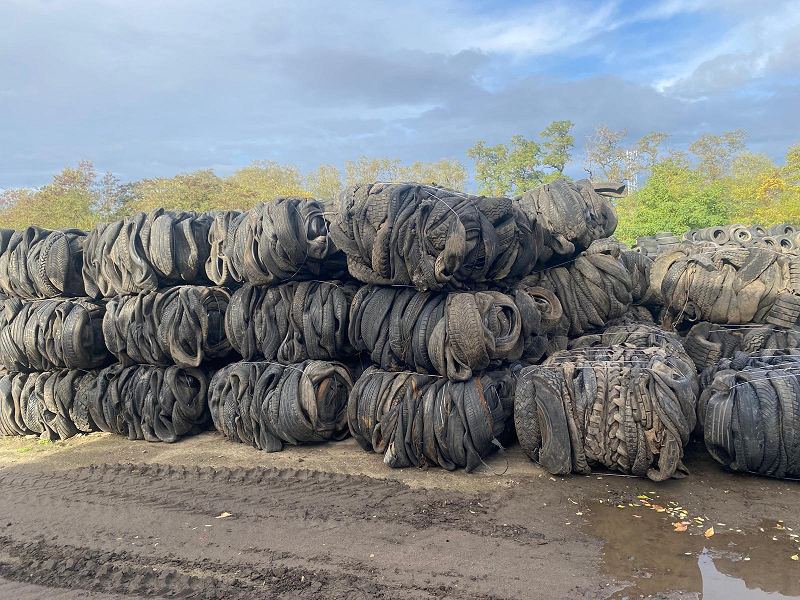
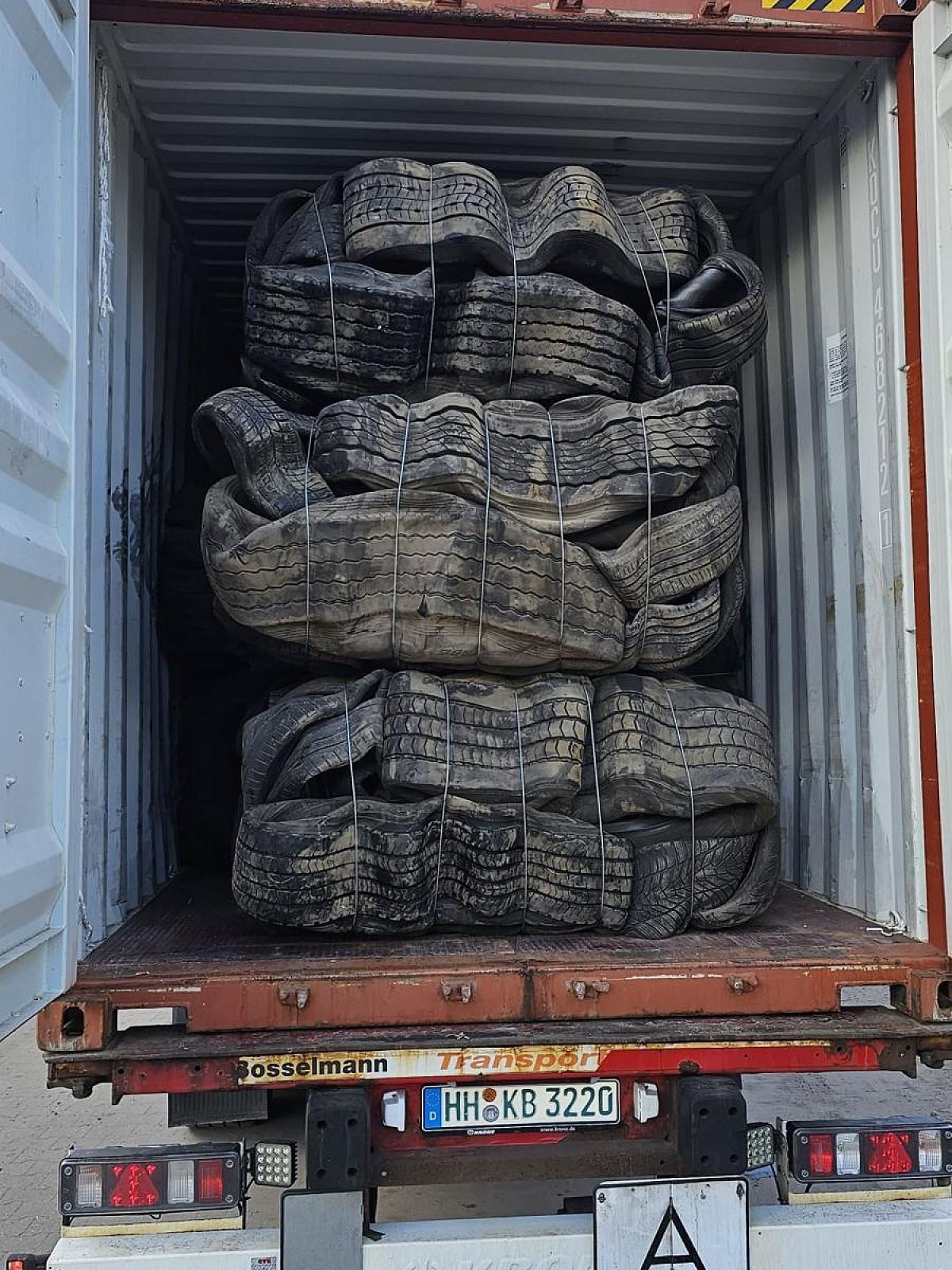
- Pressed tyre bales: the weight limit binds, the volume is not fully used
- Loose tyres: the volume limit binds by a wide margin, the container is mostly filled with air
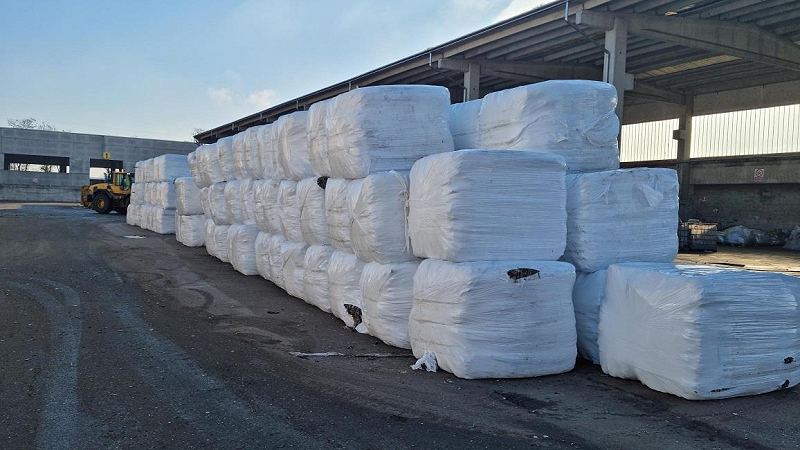
- Light plastic bales and film: depending on press density, usually the volume limit
- Shred, granulate and solid recovered fuel: depending on bulk density and packaging, sometimes one limit, sometimes the other
The stowage factor as a working figure
The stowage factor is the reciprocal of density and is given in cubic metres per tonne. It answers the only question that matters before loading: how much space does one tonne of this material take up?
The calculation is simple. Divide the internal volume by the stowage factor and you get the tonnage that fits by volume. If that result is above the permitted payload, weight binds. If it is below, volume binds. For a 40 foot standard container with about 67 m³ and a payload limit of 26 tonnes, the dividing line runs at a stowage factor of about 2.6 m³ per tonne.
In practice nobody calculates with the full internal volume. Gaps remain between the bales, space is left at the front wall for lashing, and the cargo has to be dischargeable again at destination. A utilisation of 90 to 95 per cent of the theoretical volume is a realistic assumption for well-matched bales.
Bale dimensions and container width
The internal width of a sea container is around 2.35 metres. That figure determines which bale dimension makes sense. If two bales fit side by side without an appreciable gap, the floor area is used. If they do not, a strip stays unused in every row, and that strip repeats over the whole length of the container.
A worked example makes this clear. If ten centimetres of gap are left per row, over twelve metres of loading length and the full stacking height this adds up to several cubic metres of lost cargo space. For volume-limited goods that is directly lost payload and therefore a higher freight price per tonne.
That is why bale dimensions for export goods are chosen to suit the container rather than the press. Bale length counts as well: it should be such that the rows of bales fill the container length as completely as possible and no half bale length is left over at the end. Dimensions that fit cleanly as a row of two or three across the container width are therefore common in the market.
Stowage and securing
Cargo that can move will move. At sea a container is subjected to accelerations in every direction, to impacts during handling and to braking forces on the road. Lashing and stowage have to absorb these forces, not merely prevent the load from sliding when the lorry pulls away.
The first rule is to stow tight. Goods packed close together and flush against the walls cannot accelerate. Gaps are closed rather than accepted. Only where a tight fit cannot be achieved do lashings, dunnage bags and separating nets come in.
The second rule concerns weight: distribute it evenly, heavy goods at the bottom, and keep the load as symmetrical as possible about the longitudinal axis. Loading to one side produces a tilt during crane handling and uneven axle loads on the road.
- Stow tight, start at the front wall, close the gaps
- Distribute weight evenly over the floor area, no point loads on a small area
- Heavy layers at the bottom, light ones on top, so the load does not become top-heavy
- Secure the door area so that nothing falls out when it is opened
- Lash the last row or secure it with a separating net where a tight fit cannot be achieved
Seal, weighbridge ticket and VGM
After loading, the container is closed and sealed. The usual device is a bolt seal to ISO 17712, a steel bolt with an embossed, consecutive number. It can only be opened destructively.
The seal is applied by whoever loads, as a rule the shipper or the shipper's agent at the place of loading. The number has to appear on every document accompanying the container: packing list, loading note, bill of lading, export declaration and, for notifiable waste, the movement documents. At destination it is checked whether the number on the door matches the number in the papers.
Weighing is done on a calibrated weighbridge. The weighbridge ticket states date and time, the registration of the vehicle, the container number and the gross, tare and net weights. It is the basis for the invoice, for the freight settlement and for the waste documentation.
Since 2016, SOLAS chapter VI regulation 2 has additionally required a verified gross mass, VGM for short. The shipper must submit it in signed form to the shipping line or the terminal before the container is loaded on board. Without a VGM the container may not go on the ship.
Two methods are permitted. Method 1 weighs the fully packed and closed container as a whole. Method 2 adds the individual weights of cargo, packaging and securing material to the tare weight of the container and requires a certified procedure. For bulk and baled goods method 1 is the usual route, because the weighbridge is needed anyway.
The documents that go with the cargo
The packing list is the document that describes the cargo. It belongs with every container and is read both by customs and by the consignee.
It usually contains shipper and consignee, invoice and order number, container number and seal number, the number and kind of packages, the description of goods with the customs tariff number, for waste additionally the waste code and the Basel code, gross and net weight, and the place and date of loading.
The entries in packing list, weighbridge ticket, invoice and bill of lading have to agree. Discrepancies in weight, in the number of packages or in the seal number lead to queries at the port of discharge and, in the worst case, to demurrage. Reconciling the figures before departure costs many times less than clarifying them afterwards.
We put together cargo, weighing documentation and papers for each container, and agree bale dimensions and the loading plan with the consignee before the first shipment.
Frequently asked questions
- How much fits into a 40 foot container?
- That depends on the material, not on the container. What matters is whether the volume limit or the weight limit bites first. With pressed bales it is almost always the weight, with loose or light goods the volume.
- Why press the material at all?
- Because loose goods fill the container by volume long before the payload is reached. Shipping air means paying the same freight per container and getting fewer tonnes for it.
- Who is liable for an incorrect VGM?
- The shipper. The shipper determines the verified gross mass, submits it and signs it. Terminal and shipping line may not take a container on board without a valid VGM.
- What happens if the seal number does not match?
- Then the container counts as opened. Customs and the consignee inspect the contents, clearance is delayed, and costs arise for the inspection and the standing time. That is why the number is photographed when it is applied and carried over into all the papers.