The basic problem: the container is full before it is heavy
A 40-foot standard container holds around 67 cubic metres. What it may carry depends on the container, the chassis and the road rules of the destination country, but it is almost always well above what loose car tyres weigh in that volume. Loosely stacked waste car tyres reach only about 100 to 150 kilograms per cubic metre, a sector-typical figure, because there is almost nothing but air between and inside the tyres.
A simple piece of arithmetic follows. Load loose and you pay sea freight for air. The container is full long before the permitted payload is reached. Freight, however, is charged per container and not per tonne. Every tonne that does not travel makes the tonne that does travel more expensive.
Over short distances this hardly matters. On a sea voyage to West Africa or the Far East, freight is a substantial part of the calculation. That is exactly where loaded density decides whether a deal works or not.
What baling changes about the load
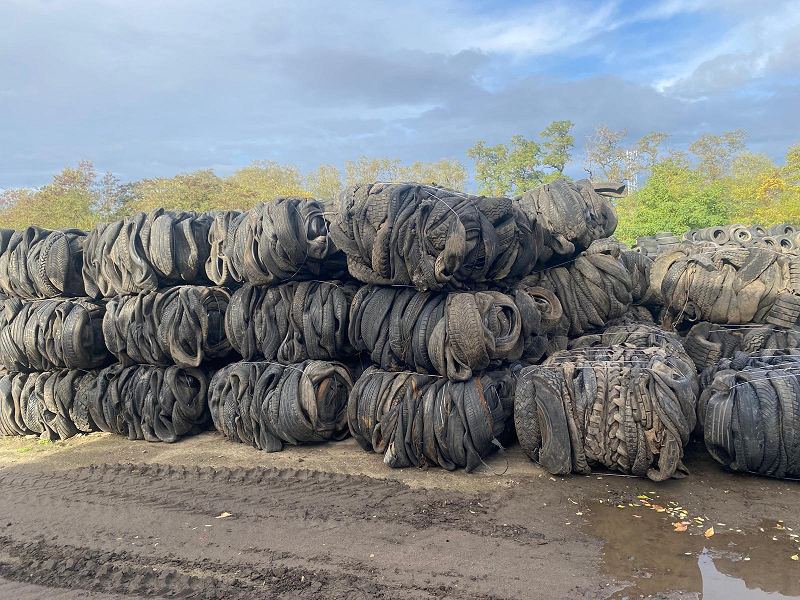
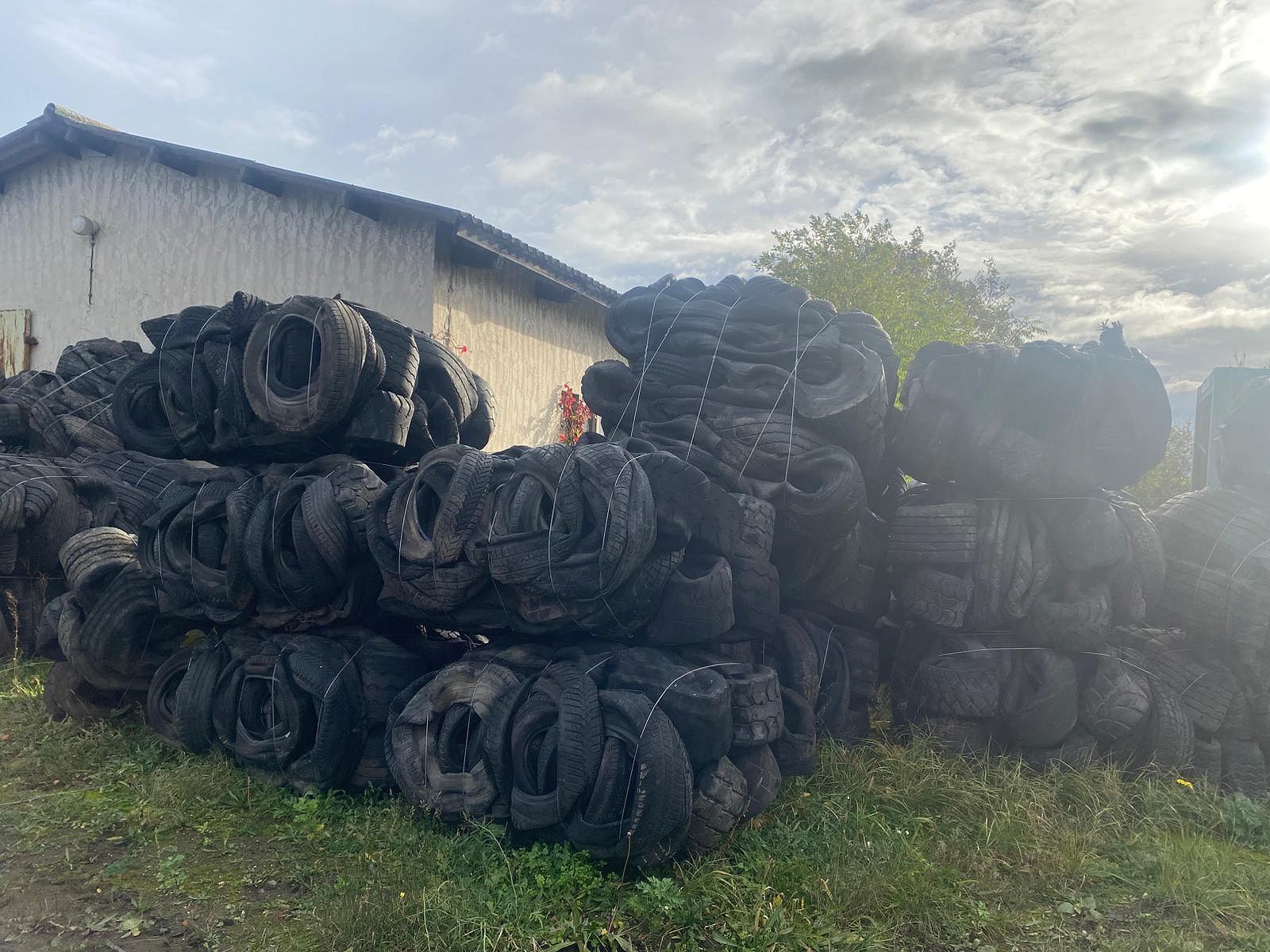
A baling press compacts loose tyres into a solid block. Bales of around 900 to 1,100 kilograms at roughly one cubic metre are common in the market, depending on the press and the tyre mix. That raises the loaded density several times over compared with loose goods.
The consequence is a change of constraint: the container now reaches the weight limit first and no longer the volume limit. That is the state you want, because freight per tonne is then as low as it can be. The figures below are sector-typical orders of magnitude and not an assurance; the actual number depends on the press, the type of tyre and the weight limits on the route.
It is worth noting that the weight limit is rarely the theoretical payload of the container. What usually binds is the permitted gross weight of the truck in the country of departure or destination, the shipping line's own limits and the axle loads. Anyone loading up to that limit plans the last layer by the weighbridge and not by eye.
| Form of load | Sector-typical density | What binds first |
|---|---|---|
| Loose car tyres | around 100 to 150 kg per cubic metre | Volume |
| Loose truck tyres | around 150 to 200 kg per cubic metre | Volume |
| Tyre shred | around 350 to 450 kg per cubic metre | usually the weight |
| Pressed bales | around 700 to 900 kg per cubic metre in the container | Weight |
How a baling press works
The principle is simple. The tyres are filled into a chamber, a hydraulic ram presses them together, and while the pressure is on, wires are fed through the chamber and twisted. The ram then retracts, the bale springs back a little and is held by the wires alone.
Five to seven wires per bale are usual, depending on the machine and the type of tyre. The wire is the actual safety component: if it breaks, the bale relaxes instantly. For that reason nobody works underneath or immediately beside a bale whose binding looks damaged.
Press force and chamber size determine the weight and the dimensions of the bale. With car tyres the cycle runs quickly, because the tyres collapse into one another. Truck tyres need more force and give fewer pieces per bale, but more weight.
- A hydraulic press compacts the tyres in a closed chamber
- Binding by several wires that are twisted while the pressure is on
- Bale dimensions and bale weight depend on chamber size and type of tyre
- A damaged binding is a safety matter, not merely a cosmetic defect
A bale is a transport format, not an end product
A bale is not processed, it is transported. At the receiver the wires are cut, the bale falls apart, and the individual tyres go to the granulator, the shredder, the kiln or on to further sorting. Pressing changes nothing about the material itself.
That is also why a bale is not a mark of quality. What is inside has to be right beforehand. A bale containing foreign matter, rims or soaked material stays exactly that once it is opened, except that the receiver now has the trouble and the complaint comes back. Sorting happens before the press, never after it.
Storage area, handling and fire load
The second effect concerns the yard. The same quantity of tyres takes up a fraction of the area as bales. Bales can be stacked, while loose tyres slip, roll and fall. For a forklift a bale is one pick, whereas loose goods mean hand work or a grab.
On fire safety the picture is mixed, and it should not be talked up. A tyre store is a high fire load in any form. A pressed bale offers the fire less oxygen on the inside than a loose heap, but once it does burn it burns for a very long time and is hard to extinguish. What governs in practice are the requirements of the competent authority and the insurer on stored quantity, stacking height, clearances and access routes.
One practical point comes on top: bales take up less water than a loose heap, because the tyres are pressed into a block and only the outer faces are open. Loose tyres, by contrast, collect rainwater in their treads. That raises the loaded weight without the buyer getting any material for it, and in summer it encourages mosquito breeding. Both are reasons not to leave goods lying loose for longer than necessary.
- A considerably smaller storage area for the same tonnage
- Stackable, which makes better use of the yard area available
- Less hand work when loading and unloading, but a forklift with adequate capacity
- Defined units make weighing, counting and stock records easier
- The fire load stays high: stored quantity, stacking height and clearances follow official requirements
When loose goods are the better choice
Baling is not always worth it. The press costs time, electricity, wire and labour, and those costs have to be more than covered by the freight saved. The shorter the distance, the harder that calculation is to win for the press.
In the following cases loose goods often stay cheaper, or are simply the only workable form.
- Short truck journeys, where freight per tonne is low in any case
- The receiver inspects tyre by tyre and does not want to cut wires first
- Tipping at the destination, where a tipping trailer is quicker than handling single bales
- Small quantities, where setting up and starting the press does not pay
- The buyer has no forklift of sufficient capacity, or no area for bale handling
When shred is the better choice
Shred, meaning tyres cut down to a defined piece size, is the third form of load. It also reaches usable loaded densities and has one further advantage: the receiver can feed the material directly without reducing it first.
That pays above all when the buyer needs material of that size anyway, for instance a cement works, a power plant or a plant for further processing. Against it stands the fact that size reduction costs the sender energy, time and wear, and that steel and textile fractions have to be separated out depending on the specification. Whoever shreds is selling a specified product and then has to meet that specification.
In practice the decision comes down to one question: who bears the cost of size reduction more sensibly, the sender or the receiver? If the receiver has its own plant with spare capacity, the bale is the cheaper form of load. If it has to buy the material in and use it at that size anyway, it will pay a correspondingly higher price for shred. This question is settled before the offer, not after it.
Part-worn tyres never go into the press
One line is clear: tyres that are meant to go back on a vehicle are not baled. The press force deforms the tread, kinks the sidewall and can damage the bead core. What comes out of the bale is a waste tyre, even if it was a saleable part-worn tyre before.
Part-worn tyres are therefore stacked individually or stowed in layers in the container, mostly by hand and often nested in rows. That costs loading time and loaded density, but it is the price of the goods still being goods at the destination. If a lot contains both, they are separated before loading and loaded separately.
We buy waste tyres, sort, press, load and take on the transport paperwork. Whether bales, loose goods or shred work out cheaper in a given case depends on quantity, distance and what the receiver can process. That can be worked through in advance.
Frequently asked questions
- How much does a waste tyre bale weigh?
- That depends on the press and the tyre mix. Bales of around 900 to 1,100 kilograms at roughly one cubic metre are common in the market; considerably smaller and larger formats exist as well. Whoever buys or sells should agree weight and dimensions specifically instead of relying on an average figure.
- Does the receiver have to open the bales?
- Yes. The bale is only a transport format. At the destination the wires are cut, the bale relaxes and the tyres are loose again. Only after that does the actual processing follow. The wire is normally collected separately and recovered as scrap.
- Can part-worn tyres be baled if you press gently?
- No, and it is not a question of care. Even moderate press force over a longer period deforms the tread and the sidewall and can damage the bead. A tyre that is meant to be driven again is stowed individually. Anything else destroys exactly the added value the tyre was sorted out for.
- When does baling not pay?
- When the freight saved does not cover the cost of press, wire, electricity and labour. That is typically the case on short truck journeys, with small quantities, and where the receiver wants to inspect the tyres individually or simply tip them out. With sea freight over long distances the picture almost always turns in favour of bales.