What a specification has to do
A specification does not describe how good a material is. It describes what both sides will measure after loading to decide whether the delivered goods match the agreement. That difference has consequences. A sentence that cannot be re-measured helps neither side in a dispute, however reassuring it sounds when the contract is signed.
The most common mistake is the bare nominal value. The phrase 5 percent fines says nothing on its own. It does not say what counts as fines, which method is used, what quantity the value refers to, or at what point the delivery is off-spec. Only a definition, a test method, a reference quantity, a tolerance band and a cut-off point turn a wish into a testable clause.
A workable parameter therefore has four parts: the quantity itself, the test method, the nominal value with its tolerance, and the consequence if it is exceeded. If one of those parts is missing, the argument moves from measurement to interpretation.
Which parameters really matter per material
Every material has a few parameters that drive price and usability, and many that only fill paper. What matters are the quantities that constrain the buyer's process: chlorine content in a cement kiln, wire content in pyrolysis, foreign polymer content at a compounder.
The table lists, per material group, the parameters that contracts regularly cover and the method or reference quantity that buyers and sellers typically rely on. It is not a minimum catalogue. The sensible approach is to define three to five parameters sharply and to handle everything else through a negative list.
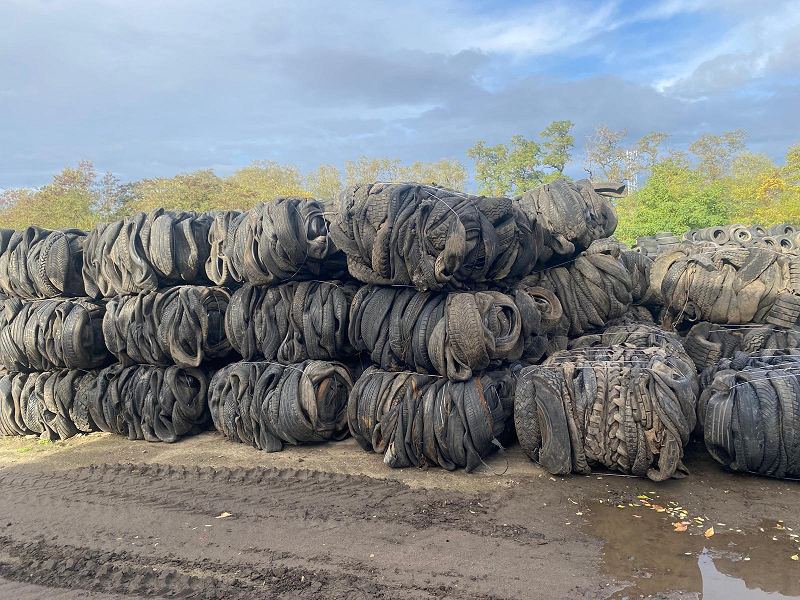
For baled end-of-life tyres the most important question is not a number but a boundary: which tyre types are included, which are expressly excluded, up to which rim size, and whether truck tyres are in. Bale weight, bale dimensions and the type of binding then decide how much material fits into a container and whether it survives the journey.
| Material | Parameters that contracts regularly cover | Method or reference quantity |
|---|---|---|
| Baled end-of-life tyres | Tyre types included and excluded, rim sizes, share of truck tyres, bale weight, bale dimensions, binding, moisture, foreign matter | Visual check and count per bale, weighing, dimensions in centimetres |
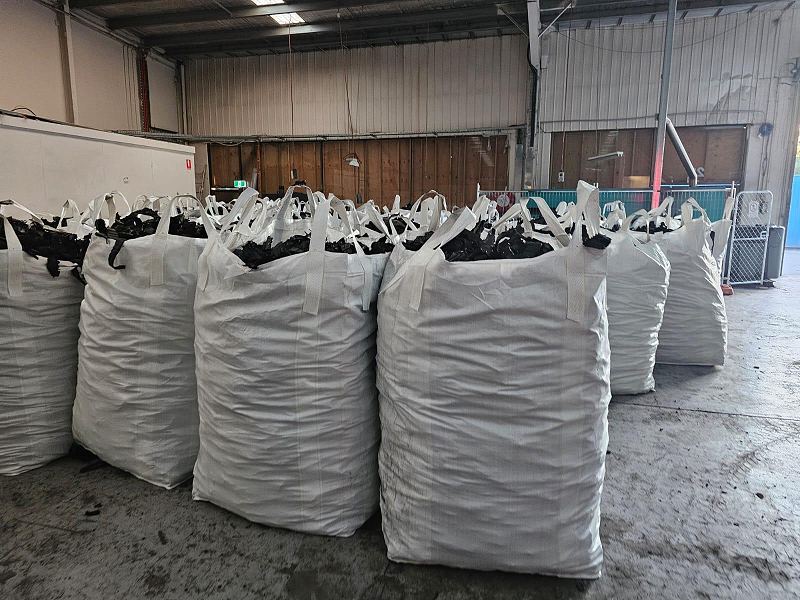
| Shred and TDF | Nominal size and its definition, oversize fraction, wire content, free wire, fines, moisture, ash, sulphur, chlorine | Sieve analysis, drying at 105 degrees Celsius, loss on ignition, elemental analysis |
| Rubber granulate and powder | Grain size distribution across the sieve stack, steel and textile residue, bulk density, colour, moisture | Sieve analysis with a defined sieve stack, weighing of the residues, bulk density in a measuring cylinder |
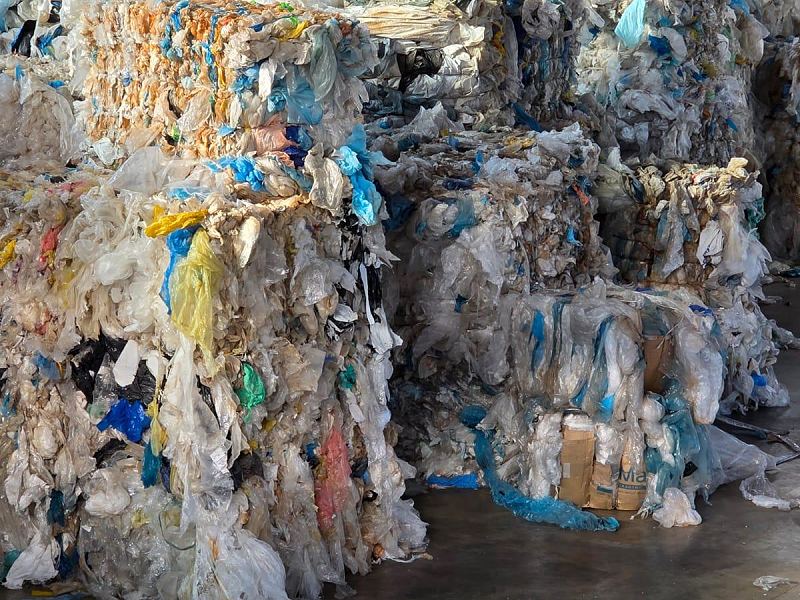
| Plastics | Polymer and type, trading form (bale, regrind, flake, regranulate), melt flow index, colour, foreign polymer and foreign matter, moisture | Polymer identification, melt flow index to ISO 1133, hand sorting of a sub-sample |
| SRF and RDF | Particle size D95, moisture, ash, chlorine, calorific value, impurities such as PVC and metals | Standard test methods for solid recovered fuels, classification to EN ISO 21640 |
Positive list and negative list
A specification has two halves. The positive list describes what must be in the material. The negative list describes what must not be in it. Many specifications consist of the first half only, and that is exactly why most claims arise. People rarely argue about whether there was enough LDPE in the bale. They argue about what else was in it.
The negative list has to be concrete and, where possible, name a limit. The wording free from foreign matter is not a limit, because no secondary raw material is free from everything. What works is either a zero clause for a few clearly named substances whose presence makes the load unusable, or a number with a test method.
- Positive: material group, type of origin, trading form, grain or bale dimensions and the unit of quantity per lot
- Positive: each characteristic with a nominal value, a tolerance and a test method
- Negative: expressly excluded substances with a zero or maximum limit, such as metal parts, soil, wood, textiles, liquids
- Negative: excluded sub-streams, such as certain tyre types, hazardous waste or medical waste
- Negative: packaging and cargo residues that are not part of the goods
- Both: a statement of which deviation leads to rejection and which only to a discount
Sampling: no rule, no proof
A measured value is only as good as the sample it came from. In bulk goods, the composition varies across a load more than the laboratory analysis varies. A sample taken from the top layer of a container describes the top few centimetres, not the load. Sampling therefore belongs in the specification, not in a footnote.
Two points are regularly forgotten. First: who takes the sample, when it happens and who may be present. Second: retained samples. Without sealed retained samples on both sides, it is no longer possible after arrival to establish whether a deviation came from the goods, from the transport or from the sampling.
- Lot definition: what a value refers to, for example per container, per batch or per 1,000 tonnes
- Increments: number and points of withdrawal, spread across the loading operation and not taken from one spot
- Composite sample: combining and reducing to the laboratory sample by a defined procedure
- Sample quantity: enough for all agreed tests and for one repeat test
- Retained samples: two sealed samples, one held by each side, with an agreed retention period
- Responsibility: who takes the sample, who may attend and how the withdrawal is documented
Asking for certificates of analysis properly
A certificate of analysis is a statement about one particular sample from one particular lot at one particular time. It is not a property of the supplier and not a standing promise. A certificate belonging to a different lot is not a certificate for the delivery in hand, even if it names the same material.
Four entries decide whether it can be used: the testing laboratory, the method applied with its standard reference, the date of testing, and the lot or sample number that can be matched to the delivery. Without the method, two certificates cannot be compared, because the same quantity comes out differently depending on the procedure. That applies in particular to moisture, ash and particle size.
Whether the laboratory has to be accredited also belongs in the contract. It is common in the market to require a laboratory accredited to ISO/IEC 17025 for the parameters that decide disputes and to accept the works laboratory for routine production control. A reduced test scope per lot with a full test at fixed intervals is equally common.
Independent pre-shipment inspection
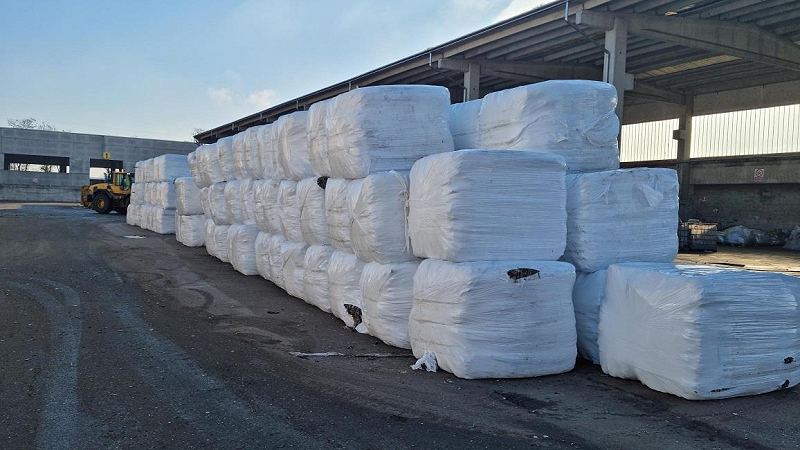
An independent pre-shipment inspection checks what can be seen, weighed and sampled: material type and sorting by visual assessment, bale dimensions and bale weights, the condition of the container, the loading operation, the sealing and the photo documentation. It does not replace laboratory analysis. An inspector cannot see chlorine content or melt flow index, and can only assess the inside of a closed bale on a spot-check basis.
The inspection is useful where it starts early: during loading, not after the doors are closed. After that, only the seal can be checked. The clause therefore needs the timing, the scope, the number of units to be opened, and the duty to photograph every container during loading and after closing, with the seal number visible in the picture.
Two points are often left open. First, the cost: arrangements are common in the market under which the party ordering the inspection pays first and the cost passes to the other side if a deviation is proven. Second, the consequence. An inspection clause without a consequence is worthless. The options are rejection, a price discount under an agreed formula, or re-sorting at the supplier's cost, each with a deadline and with a statement of who decides.
How the specification gets into the contract
A specification the contract does not refer to is just an e-mail. It needs a number, a version and a date, and the contract has to name exactly that version as an annex. Changes only take effect when both sides sign a new version. Otherwise a dispute sets the version the buyer saved last against the version the seller sent last.
Four clauses connect the specification to the contract. The quality clause makes the specification the agreed quality of the goods. The tolerance clause sets out which deviation is still contractual. The dispute clause names a referee laboratory whose result both sides accept, and settles who instructs and pays it. The order of precedence clause says what governs when contract, specification and order confirmation contradict each other.
Deadlines come on top of that. A notice period without a reference date is useless. Periods running from discharge at the port of destination or from arrival at the plant are common, combined with a duty to store rejected goods separately and unprocessed until the matter is settled. Once the goods have been processed before testing, proof is practically impossible.
Anyone who supplies or buys regularly keeps the specification as a separate numbered document rather than a paragraph in an offer. On enquiries we agree parameters, sampling and test scope in writing before the first load.
Frequently asked questions
- Is it enough to adopt the buyer's specification?
- Only if the supplier can actually measure or exclude every parameter in it. An adopted specification with values that were never tested in the supplier's own process shifts the whole risk to the supplier. It is better to go through every point once and change the contentious values before signing rather than after the first claim.
- What is a sensible tolerance band?
- One that covers the real variation of the material and the variation of the test method while still leaving the material usable for the buyer. Two numbers belong in it: the tolerance for the individual value and, for running deliveries, a mean across several lots. Without the mean, a whole series of just-acceptable deliveries can sit permanently at the limit.
- Who should take the sample?
- The most robust arrangement is sampling by an independent third party in the presence of both sides or their representatives. Where that is not possible, the procedure should at least be fixed in the contract and the withdrawal documented with photographs. What matters in every case is that both sides receive a sealed retained sample.
- What if two laboratories report different values?
- That is normal and not a sign of fraud. This is why the contract should state from which difference onwards a third laboratory decides, which laboratory that is, and which sample it tests. Without retained samples that third test has no basis, and the question stays open.